Choosing a hydraulic cylinder for a dump trailer involves more than matching the cylinder to the trailer’s advertised payload. The cylinder must provide enough force to start lifting the loaded body, fit inside the available installation space, and produce sufficient stroke to reach the intended dumping angle.
A cylinder selected only by nominal tonnage may stall at the beginning of the lifting cycle, raise the body too slowly, or fail to provide complete unloading. An oversized cylinder can also create problems by increasing oil demand, weight, cost, and structural loads.
The best selection method evaluates the trailer body, payload, hinge position, cylinder geometry, hydraulic pressure, flow rate, mounting dimensions, and required cycle time as one complete system.
Why Trailer Capacity Alone Is Not Enough
The same cylinder may perform differently on two trailers with the same payload rating. The difference is caused by body geometry and load distribution.
A properly selected dump trailer hydraulic cylinder must create enough turning force around the rear hinge to lift both the dump body and its payload. HUTCHIN’s dump truck application page identifies telescopic cylinders as lifting solutions for dump truck and trailer bodies.
Important variables include:
Empty dump-body weight;
Maximum payload;
Position of the load’s center of gravity;
Distance from the center of gravity to the rear hinge;
Cylinder attachment points;
Cylinder angle at the start of lifting;
Available hydraulic pressure.
The first part of the cycle is often the hardest. When the body is almost horizontal, only part of the cylinder’s total force contributes to upward movement. As the body rises and the cylinder angle changes, the mechanical advantage may improve.
Step 1: Determine the Required Cylinder Force
The theoretical cylinder force is calculated by multiplying hydraulic pressure by the effective piston or stage area.
However, theoretical force is not the same as effective lifting force. The cylinder’s angle, attachment position, hinge geometry, friction, and pressure losses must also be considered.
The lifting requirement should be evaluated as a moment around the trailer’s rear hinge. This is particularly important when the payload may become concentrated toward the front of the body.
A reliable calculation therefore requires more than the trailer’s gross weight. Buyers should provide the body length, hinge location, cylinder coordinates, load center, maximum pressure, and expected payload distribution.
Step 2: Identify the Required Stroke
Stroke is the total distance the cylinder extends. It must be sufficient to move the body from its resting position to the intended dumping angle.
Too little stroke can leave material trapped inside the body. Too much stroke may cause structural interference, over-rotation, excessive cost, or an unnecessarily long cylinder.
Stroke should always be considered together with closed and open length. A cylinder may offer the correct stroke but still be impossible to install when fully retracted.
Step 3: Select the Correct Number of Stages
Dump trailers commonly use telescopic cylinders because they require a long lifting stroke but offer limited space under or in front of the body.
A multi stage hydraulic cylinder divides the required travel among two or more nested sections. HUTCHIN’s commercial series includes two-, three-, four-, and five-stage configurations with different stroke, closed-length, and open-length combinations.
A two-stage cylinder may be appropriate when there is sufficient closed-length space. Three or more stages may be required when the trailer needs a long extension from a short installation envelope.
More stages are not automatically better. Each additional stage affects:
Cylinder outside diameter;
Sealing complexity;
Extension sequence;
Oil volume;
Force during later stages;
Manufacturing and maintenance requirements.
The correct objective is to use enough stages to achieve the required travel without adding unnecessary complexity.
Step 4: Verify Closed and Extended Dimensions
For a replacement project, record the existing cylinder dimensions before ordering:
| Measurement | Why It Matters |
|---|
| Retracted length | Confirms the cylinder fits when the body is lowered |
| Extended length | Helps determine the final tipping angle |
| Total stroke | Confirms the available lifting travel |
| Pin-to-pin distance | Determines mounting compatibility |
| Base mount position | Influences initial lifting leverage |
| Upper mount position | Controls the body’s movement path |
| Pin diameter and width | Determines whether the cylinder fits the brackets |
Do not rely only on the trailer brand or model. Previous repairs or frame modifications may have changed the original dimensions.
Step 5: Match the Hydraulic Pressure and Oil Volume
Cylinder force depends on actual operating pressure, while movement speed depends mainly on flow rate and effective area.
A higher pressure rating does not mean the cylinder will automatically lift faster. If the pump flow is insufficient, a larger cylinder may move more slowly because it needs more oil for each inch of travel.
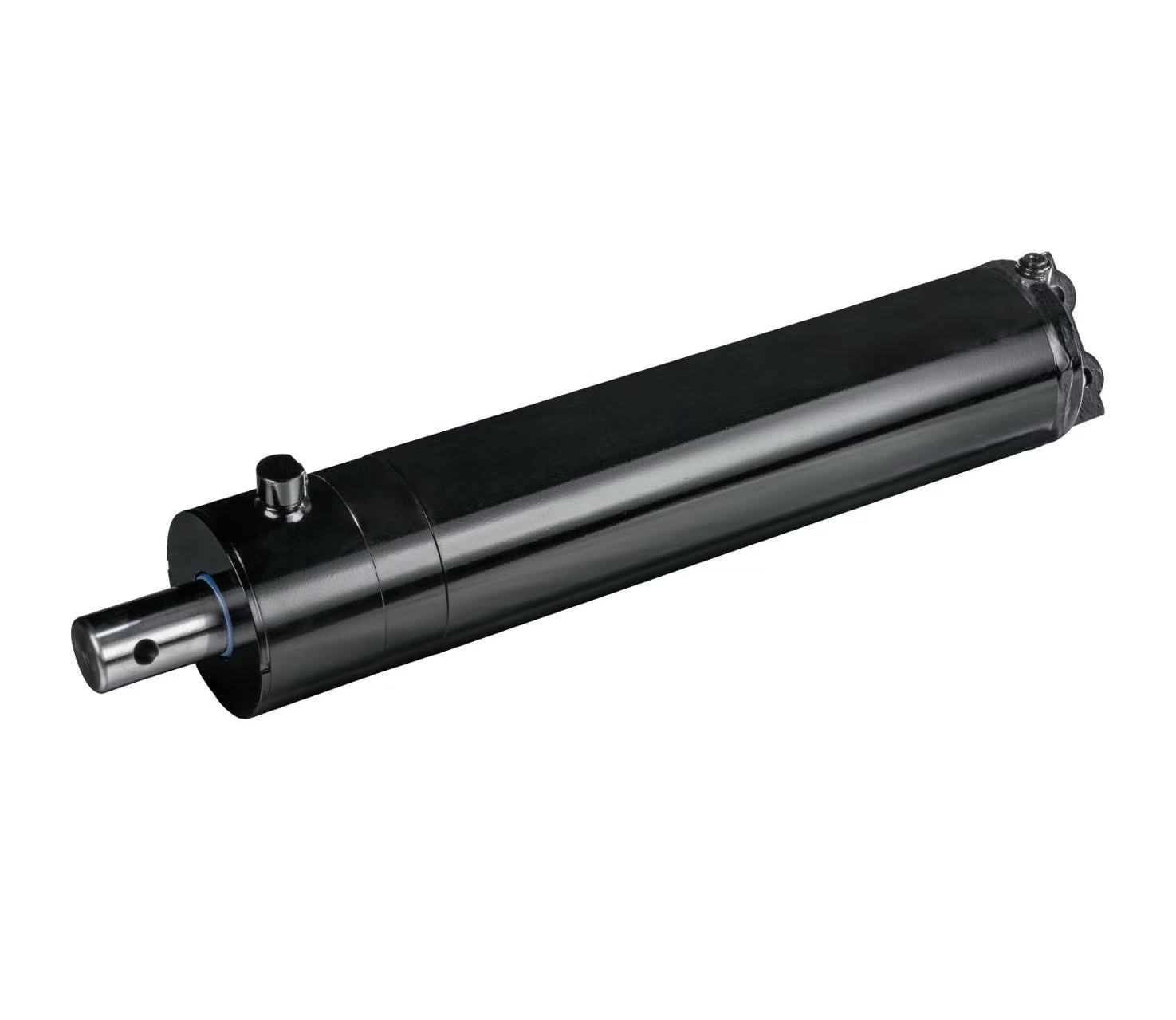
The reservoir must also contain enough usable oil to fully extend the cylinder without allowing the pump to draw air. HUTCHIN’s multi-stage cylinders for the Americas are listed as single-acting, cross-tube-mounted units with a 2,500 PSI pressure rating, while double-acting options can be customized.
Step 6: Choose a Suitable Mounting Arrangement
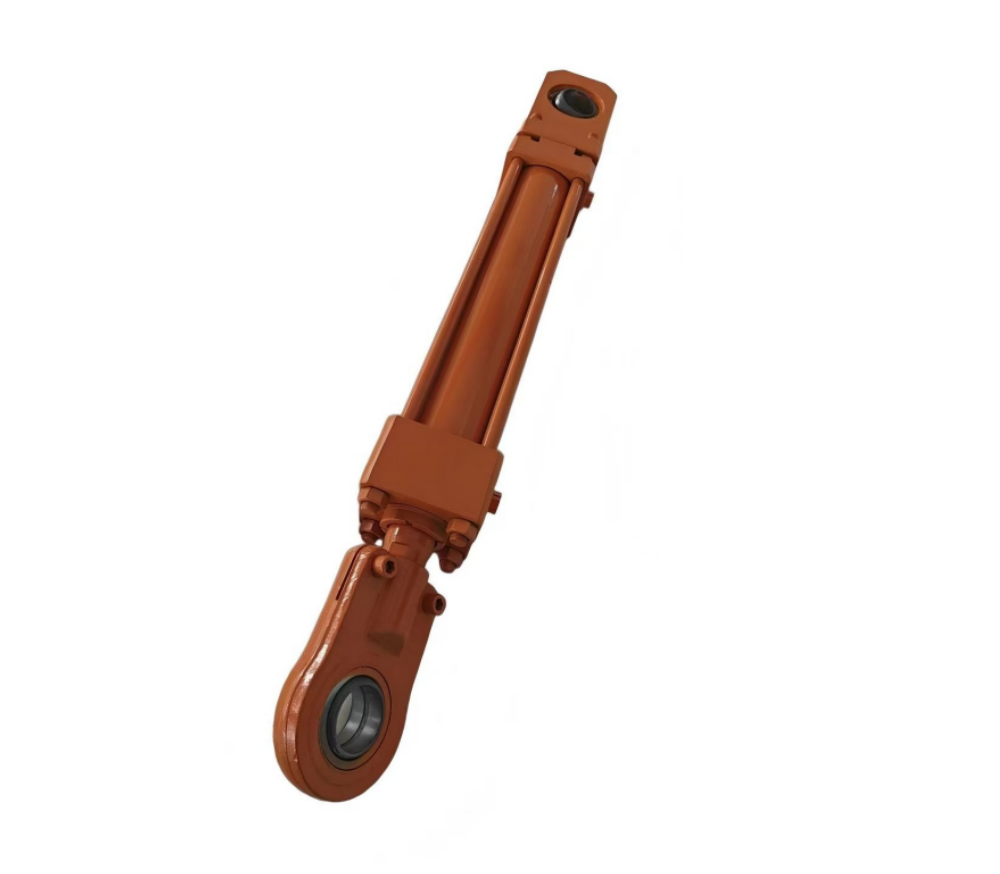
Common mounting arrangements include cross-tube, trunnion, and pin-eye connections.
The mount must permit the cylinder to pivot throughout the complete lifting arc without binding. Pin axes should remain aligned, and brackets must be strong enough to transfer the cylinder force into the chassis and body.
Mounting brackets should not force the cylinder to compensate for a twisted frame. Persistent side loading can damage bearings, sleeves, seals, and mounting pins.
When Is a Custom Cylinder Necessary?
A standard cylinder may not be suitable when the trailer has an unusual body length, restricted installation space, non-standard mounting brackets, a special port position, or an uncommon pressure requirement.
In these cases, a custom hydraulic cylinder manufacturer can evaluate the complete geometry and produce a cylinder based on the required bore, stroke, pressure, mounting style, and working environment.
FAQs
Is a telescopic cylinder better than a single-stage cylinder?
A telescopic cylinder is generally more suitable when a long stroke is required but closed-length space is limited. A single-stage cylinder can work when the machine has sufficient installation length or uses a linkage hoist.
How many stages does a dump trailer cylinder need?
The answer depends on the required stroke and available retracted space. Compact trailers requiring a high tipping angle usually need more stages.
Can I increase the relief valve pressure to lift a heavier load?
The pressure should not be increased beyond the ratings of the cylinder, pump, valves, hoses, fittings, and equipment structure. Increasing pressure without engineering verification can damage the system.
Conclusion
Choosing the correct dump trailer cylinder requires a combined evaluation of lifting force, body geometry, stroke, closed length, stage count, pressure, flow, oil volume, and mounting dimensions.
Providing the manufacturer with a trailer drawing, maximum load, hinge position, hydraulic-system information, and complete cylinder measurements greatly reduces the risk of an incorrect selection.